Posts

Showing posts from January, 2017

What is Internal Table in SAP ABAP
Image
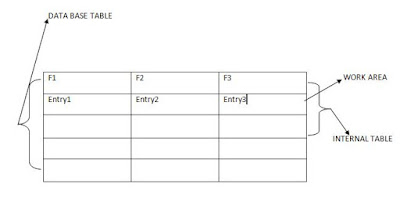
Internal Table in ABAP program In this post, we have to learn SAP ABAP internal tables and types of internal table and internal table program tutorials and what is work area and technical features of table’s Operations on internal tables that are creating, changing, appending, modifying and deleting internal tables in SAP program. Internal Tables Internal tables are used to take data from fixed structure and inserting it in working memory in ABAP.Line by line stored in the memory and each line has the same structure. We are using internal table whenever we want to make changes to data base tables. Internal tables acts as function of arrays, dynamic data objects and implements the dynamic memory management in programs. Internal table data types There are 3 types of data types Line type,Key and Table type. Line Type The line type of an internal table can be any data type and it is  a structure. Each component of the structure is a column in the i...
Constant and Literals in SAP ABAP programming

Constant and Literals in SAP ABAP programming In SAP,there is available two types of literals that are Numeric and Character.Literals are unnamed data objects which we can create within the ABAP program.They are predefined by their value and we can't change value of literal.We creates constants using declarative statements .Constants are named data objects and assigning a value to it and can not be changed constant while executing the program. Literals Constants Literals Numeric literals are number literals which are sequence of digits and having prefixed signs. Example:1000,-45,+72. Character literals are sequence of alphanumeric characters in the ABAP program declared within the single quotation marks.They have predefined data type C. Text field literals  REPORT Z_LIT_EX. Write 'sinu abap tutor'. Write / 'ABAP Tutorials'. String field literals  REPORT Z_LIT_EX1. Write `sinu abap tutor `. Write / `ABAP Tutorials'. The output is s...

SAP ABAP Variables Types

SAP ABAP Variables Types In the previous post,we have learned data types in sap abap with examples and difference between data and types in abap and parameters in abap with example along with elementary data types and reference types ,structure types and table types .So now let us learn the variables in SAP and their definition and how to declare them and what is the role of variables in sap abap. We are using Variables in SAP that are data objects used to store values within the allotted memory area of a program. We can change the content of variables with the help of ABAP statements. Each variable in ABAP has a different type, which determines the size and layout of the variable's memory; the range of values that can be stored within that memory; and the set of operations that can be applied to the variable. We must be declare all types of variables before they can be used. we can declare variable like DATA <f> TYPE <type> VALUE <val>. Here <f...

SAP ABAP Data Types

SAP ABAP Data Types   Data types which are used  to store information of various data types like character, integer, floating point, etc.So as a ABAP consultant ,to write any code ,we have to understand data types and how to declare data types and how much space will take every data type variable in the SAP system. Type Field  Byte field     X Text field     C Integer     I Floating Point    F Packed number    P Text string   STRING Based on the data type of a variable, the operating system allocates memory and decides what can be stored in the reserved memory. Elementary Data Types in SAP ABAP offers the programmer a rich assortment of fixed length as well as variable length data types. Some of the fields and numbers can be modified using one or more names as the following: byte numeric character-like Type Type Length Type range X 1 byte           ...

Basic Syntax and Screen Navigation in SAP ABAP

Image
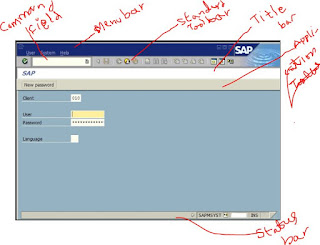
Basic Syntax and Screen Navigation in SAP ABAP To understand SAP ABAP screen navigation and basic syntax , we should have basic knowledge of how to log into sap system, ABAP Editor and how to Logout and from SAP system. I hope this post helpful for new ABAP learners to understand sreen navigation and the standard toolbar functionality and basic systax of ABAP programming. How to log in into SAP system First of all, we log on to SAP server, then SAP login screen will ask for client,User ID , Password and language details. We have to provide a valid client, user ID and Password and language and  press Enter . ABAP Screen Navigation  Menu Bar : Menu bar is the top line of dialog window. Standard Toolbar : Most standard functions such as Top of Page, End of Page, Page Up, Page Down and Save are available in this toolbar. Title Bar : Title Bar displays the name of the application/business process you are currently in. Application Toolbar: Application specific m...

SAP ABAP Environment

SAP ABAP Environment As a ABAP developer, to learn the coding, we have to understand ABAP environment and its tools,statements,execution,activation and saving the ABAP objects and writing the ABAP programmer. We can understand ABAP environment very well by using Reports to familiarize you with general ABAP statements and tools. ABAP reports are used in many applications. In this chapter, we will look how easy it is to write a simple ABAP Report. Hello ABAP program Let's get started with the common “Hello World” example. Each ABAP statement starts with an ABAP keyword and ends with a period. Keywords must be separated by at least one space. It does not matter whether we use one line or several lines for an ABAP statement. We enter our code using the ABAP Editor that is a part of ABAP Tools delivered with the SAP Net Weaver Application Server ABAP (also known as ‘AS ABAP’). Application server with its own database, ABAP run-time environment, and ABAP development tools...

SAP ABAP programming overview

Image
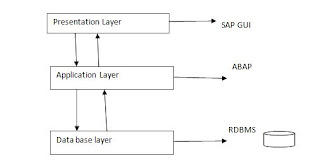
Every SAP ABAP consultant should have overview on ABAP application programming process in SAP system to understand SAP software 3 tier client/server technology. SAP ABAP programming overview ABAP stands for Advanced Business Application Programming . It is a 4th generation language. Currently it is competes with Java, as the main language for SAP application server programming. Now  let us learn architecture of SAP system. The 3-tier Client/Server architecture of a typical SAP system. The Presentation layer contains of any input device that can be used to control SAP system. This could be a web browser. All the central processing work takes place in Application server . The Application server is not just only one system in itself, but it can be multiple instances of the processing system. The server communicates with the Database layer that is usually kept on a separate server, mainly for performance reasons and also for security. Communication happens between each ...

Pooled and Cluster tables in SAP ABAP

Image
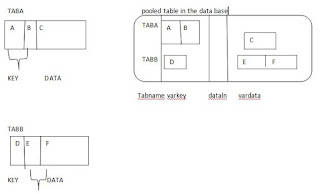
Pooled and Cluster tables in SAP ABAP Pooled and cluster tables in SAP ABAP are also kind of SAP table .But these are used to store internal infromation of SAP system that are screen sequences,program parameters, temporary data, continuous texts such as documentation. Table Pools The data from several different tables can be stored together in a table pool or table cluster. Tables assigned to a table pool or table cluster are indicated as pooled tables or cluster tables. Table Pools :A table pool corresponds to a table in the database in which all records from the pooled tables assigned to the table pool are stored. A pool has the following structure: Field Data type Description  Tabname CHAR(10) Name of pooled table  Varkey CHAR Contains the entries from all key fields of the pooled table record as a string. Dataln  leangth of string data in vardata. Vardata  entries from the all data fileds as a string . Due to the structure of a ...

Search Helps in SAP ABAP

Search Helps in SAP ABAP Search helps in sap abap data dictionary are useful for end user to get him easy access into any dialog application with help of serch helps which shows some possible input values for his required data.   We uses the search help to assign input help (f4) to screen fields.We can create search help in the ABAP dictionary after that we can attach them screen fileds. We can display list of all possible input values for screen fileds using search help.It is a standard functionality of a SAP system. We can call an input helps from following process. Input help to display the possible input values for a field in a screen template. The system offers you a number of possible search paths. We can enter the restrictions, if required, and then start the search.  There is available two types of search helps 1. Elementary search help 2.Collective search helps 1. Elementary search help Where the data of the hit list must ...

Domain in SAP ABAP

Image
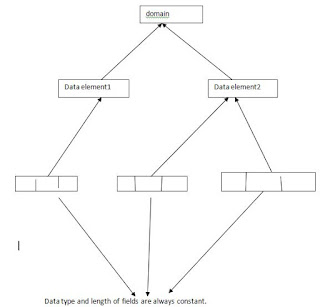
Domain in SAP ABAP Learning domains in ABAP data dictionary is the most important and basic part to learn technical aspect about the domain as abap consultant. Domains are used to define a value ranges. Each and every domain is assigned to a data element. All table fields or structure components  uses the data elements then data elements have the value range defined by the domain. The relationship between the field or component and the domain is defined by the data element of the field or component. All table Fields or components that refer to the same domain are also changed automatically when that domain is changed. The value range of all domains are defined by specifying a data type and length . The value range of a domain can be restricted by defining fixed values.  If all the fields of the table that refer to the domain can be checked against a certain table, this table can be created as the value table of the domain. We can define out...

Types in SAP ABAP Data Dictionary

Types in SAP ABAP Data Dictionary Custom defined data types can be stored for all programs in the ABAP Dictionary. This central definition of types which are used more than once in the ABAP Dictionary allows them to be changed centrally. ABAP Dictionary ensures that such changes are made at all the corresponding locations. Custom defined types provides us the same functionality as the local types that can be defined in ABAP programs with TYPES statement. What is the use of types, types defined globally in the ABAP Dictionary can be accessed in ABAP programs with TYPE statement. We can also refer to the types defined in the ABAP Dictionary when creating the type of a function module interface.  If we modify a type definition in the ABAP Dictionary, the system adjusts all ABAP programs connected with this type automatically to this change when they are recreated. There are three different types:  Data elements :elementary types and reference types. Struc...

Views in SAP ABAP

Image
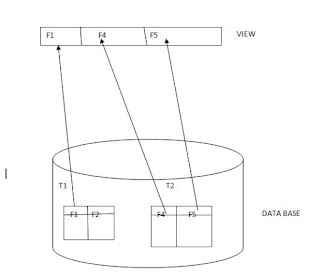
Views in SAP ABAP  Views in SAP ABAP data dictionary are important topic on which ABAP developer must have knwoledge to create views and for maintaining views. Most of the times ,data of an application object is often distributed on many tables. Using a view, we can define an application-dependent view that combines this data. The structure of such a view is defined by creating the tables and fields used in the view. Fields which are not required can be hidden, thereby minimizing interfaces. Views can be used in ABAP programs for data selection. The data of a view is collected from one or more tables, but not stored physically. The simplest form of deriving data is to choose one or more fields from a base table (projection) or to include only certain entries of a base table in the view (selection). Many complicated views can comprise several base tables, the individual tables are linked with a relational join operation. Join, Projection and Selection. Base tables o...

All about Tables in SAP ABAP

All about Tables in SAP ABAP Tables are most and import basic concept which every ABAPer should learn to understand SAP ABAP development wolrd. So tables are important topic to get ABAP programming. Tables are database independent in the ABAP dictionary,when the table is activated,the system create physical table in the SAP database and translates tables definition from the ABAP dictionary to the particular database definition. Table is defined in the ABAP dictionary with following components: Table fields Foreign keys Technical settings Indexes Table fields  define the filed names and data types of table fields Foreign keys define the relationship between the tables Technical setting used for controlling the creation of the table in the database. Indexes are used to speed up the data selection We can modify the tables with append structures and customizing includes.  We can create ,change and delete the table. Table contains the follow...

What is The Difference Between Check Table and Value Table in SAP ABAP

What Is The Difference Between Check Table and Value Table in SAP ABAP As a ABAP consultant,most of the times ,up to 7 years experience interviews,we will face check table and value table definitions interview questions and difference between check table and value table questions ,so we must be know concepts of check table and value table to crack the interview. For this we need know clear meaning of both tables. Value Table This is defined at Domain Level. Whenever creating a domain, we can enter allowed values.   For example  if we go to Domain   SHKZG - Debit/credit indicator.  Here only allowed values is H or S. Wherever we use this Domain, the system will force us to enter only these values. This is a sort of master check. To be maintained as a customization object.  This mean that if we want to enter values to this table we have to create a development request & transport the same.  Check table check table will carr...

What are Lock Objects in SAP ABAP

What are Lock Objects in SAP ABAP Lock objects are nothing but  function modules ,are working by lock requests .function modules are released by lock requests .Why we are using lock objects which provides us simultaneous access for multiple users to the same data records by the lock mechanism to prevent any congestion between interactive transactions. The function modules are created automatically when we are defining the lock objects in the system. We are creating the lock objects for table records which must be locked with a lock request and the key fields of these tables ,here we are using primary and secondary tables to create lock objects ,using foreign key relationship. for example take the 3 tables which are tab1,tab2 and tab3 here Tab1 is the primary table. TAB2 and Tab2 are secondary tables lock arguments are nothing but key fields of primary and secondary tables .Lock arguments release and call the function modules .       Cr...