Posts

Showing posts from July, 2017

How to Create SAP ABAP Query Using SQ01 Step by Step Guide

Image
How to Create SAP ABAP Query Using SQ01 Step by Step Guide You can create ABAP query objects if they do not exist in the SAP system. You can create an SAP query without  ABAP programming knowledge. ABAP Query provides users with a variety of ways to define and create different types of reports , such as Basic Lists , Stats , and Sorted Lists . ABAP query consists of four elements: Queries InfoSets Groups Translation query Queries The query component is used by end-users for Queries. You can create queries, change, and queries executed. Transaction SQ01. Trnslation component / QUERY Many texts to define queries, InfoSets, and user groups are generated. These texts are displayed in the language we choose to access the SAP system. We can compare the text or languages ​​that use this component. InfoSets InfoSets are the views of the Special Data Sources. An InfoSet Describes the fields of a data source that can be reported in the query. An InfoSet can be a...
Types of BADI in SAP

Types of BADI in SAP You can learn Types of BADI's in SAP ABAP with simple Definitions. Single Use BADI A BADI which has only one implementation (single class) is called single implementation BADI. Multi use BADI  You can define any number of active implementations can be assigned to the same definition BADI. You have to check this option .   If we want the BADI for multiple use purpose. If you have multiple-use BADI definitions, the sequence must not play any role. The disadvantqage in Multiple use BADI is, it is not possible to know which BADI is active especially in country specific version. Filter dependent BADI Using this option we can define the BADI's according to the filter values to control the add-in implementation on specific criteria. Specific country value. Custom BADI This BADI can be defined in SE18 and SE19 Tcodes which are SAP BADI Transactions ,you can define and implement sap BADI's thorough this Tcodes .Custom BADI...

BDC Recording in SAP ABAP

Image
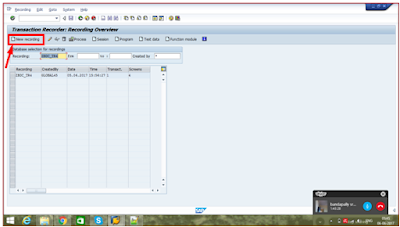
BDC Recording in SAP ABAP Here ,I explained The Steps to record any Transaction (Example: VA01) to create BDC(Batch Data Communication) Program. Step 1  Execute transaction SHDB  . Step 2  Enter name for recording  Step 3  Enter transaction to be executed Step 4  The transaction will now be executed, simply enter the values in the screen fields which you want to record.  Step 5  Once you have finished the recording and selected the save button or exit the transaction you  Creating an ABAP program Using a BDC recording   Go to SHDB Transaction Code and Click on New Recording. Give the Record name and Transaction code and click on Start New Recording Button. Now enter the Bank country and Key Now enter the Bank name ,City ,country and street.  Now Save the Recording . Now select the created record and click on Program. Now give the program title and select radio button transfer from ...

SAP Data Dictionary Tcode

SAP Data Dictionary Tcode These are important Transaction(Tcode) codes used to execute various Data dictionary Objects. SE11_OLD - abap dictionary Maintenance Basis - Dictionary Maintenance SE12_OLD - abap dictionary Display Basis - Dictionary Maintenance SE11 - abap dictionary Maintenance Basis - Dictionary Maintenance SE12 - abap dictionary Display Basis - Dictionary Maintenance SE16. SE80.       SAP Transaction codes     Data Dictionary Overview     Tables     Domain     Data element     Views     Lock Objects     Types     Search Helps     Check Table and Value Table     Pooled and Cluster Tables      Links Between SAP Tables     Data Dictionary Real time Interview Questions     Creating Structure Tutorial in SAP ABAP     Creating Domain Tutorial in SAP ABAP     Creating Type Group Tutorial in SAP AB...

Difference Between ALE and EDI in SAP ABAP

Difference Between ALE and EDI in SAP ABAP The main difference between ALE and EDI is ALE used for internal communications within the SAP Environment and EDI is meant for external communications that is communicating with Non-systems. ALE(Application Link Enabling): ALE is technology for SAP ,is used to transfer data between SAP systems . ALE is used to support integrated processes across several SAP systems . ALE includes controlled exchange of data messages guarantying  data consistency across loosely coupled applications. ALE consists three layers which are Application Services  , Distribution Services and Communication Services. ALE provides a distributed and fully integrated R/3 system. Each application is self-capable. The use of self-capable system implies a certain measure of data redundancy.Hence data has to be both distributed and synchronized. ALE uses an IDOC format to exchange data between systems, both participating systems should ...

What are The Events in Module Pool Programming

What are The Events in Module Pool Programming  Dialog(Dynpro) programming Controls the multiple screens which are integrated hierarchically to the main program(Transaction) and they are executed in a sequence. The main elements of the module pool Programming are Screens Module pools Subroutines Menus Transactions Events in Module Pool Programming(Dialog programming) In the PAI event, all of the Data from the screen is transported to the ABAP program when the automated input checks and before the primary PAI module is termed.  At the top of the last PBO module, and before the screen is displayed, all of the Data is transported from the ABAP program to any identically-named fields within the screen.  Data is transported between the screen and therefore the ABAP program at the start and finish of every dialog tread the appliance server.  There are four event blocks , each of which is introduced with the screen keyword PROCESS ...

Types of Internal Table in ABAP

Types of Internal Table in ABAP Internal tables are used to access a data in a fixed structure and storing it in working memory in ABAP. The data is stored line by line in memory, and each line(record) has the same structure. Standard Internal Tables Standard Internal Tables are default internal tables. We can use either key or index operation to read an entry . we can use either linear search or binary search to search for an entry, . We can Apply sort operation. If you are going to address the individual table entries using the index. Index access is the quickest possible access ,this is the best suitable table. We can use insert and append to add records. It have an internal linear index.  The system can access records either by using the table index or the key.  The response time for key access is proportional to the number of entries in the table.  The key of a standard table is always non-unique.  You cann...

Difference Between BAPI and RFC Function Module in SAP

Difference Between BAPI and RFC Function Module in SAP From this tutorial ,we will learn what is the difference BAPI and RFC in SAP?BAPI and RFC definitions. BAPI BAPIs are standardized programming interfaces (methods) enabling external applications to access business processes and data in the R/3 System. BAPIs provide stable and standardized methods to achieve seamless integration between the R/3 System and external applications, legacy systems and add-ons. BAPIs are defined in the BOR(Business object repository) as methods of SAP business object types that carry out specific business functions. BAPIs are carried out as RFC-enabled characteristic modules and are created within the Function Builder of the ABAP Workbench. The most critical difference btwn BAPI and FM is that BAPI can be wrapped in Business objects whereas RFC cant. The following standardized BAPIs are provided: Reading times of SAP commercial enterprise objects GetList ( ) With t...

SAP ABAP Programming Language Tutorials for Beginners

SAP ABAP Programming Language Tutorials for Beginners SAP ABAP is very easy language comparing to Java and other languages.Learning SAP ABAP is good decision to become Software consultant ,Programming wise ,ABAP can be written in simple understandable syntax ,because it is 4th generation Language ,Statements looking like English words .Non-computer graduate to computer graduate ,any one can learn ABAP Language. What is ABAP/4 Programming Language? ABAP(Advanced Business Application Programming) is a 4th generation programming language developed by SAP German Company .ABAP is used to develop SAP R/3 Applications.ABAP is an event-driven programming language. User actions and system events control the execution of an application.The “4” in ABAP/4 abbreviation is“Fourth Generation Language” or 4GL. It runs on the Application Server on the SAP R/3 System.SAP System having the ABAP Workbench tools to write ABAP programming and developing SAP Applications ,some of workbench tools are ...

Difference Between User Exit and Customer Exit in SAP ABAP

Difference Between User Exit and Customer Exit in SAP ABAP What is a USER EXIT? User Exits are implemented in the form of subroutines and also we will call them as FORM EXITs. The user exits are available in the form of includes and linked to the standard program by the SAP. These are mainly developed for the R/3 SD (Sales and distribution) module.   Some Example User Exits in SD  • USEREXIT_SAVE_DOCUMENT - To perform operations when user hits Save • USEREXIT_SAVE_DOCUMENT_PREPARE • USEREXIT_FIELD_MODIFICATION - To modify screen attributes What is a Customer Exit? Customer exits are "hooks" provided by SAP within many standard programs, screens and menus to which we can add our own code to implement Extra Functionalities based on the end-user requirement.   Customer Exits Types There are three main types of customer exits:  1. Function Module Exits 2. Screen Exits 3. Menu exits Customer Exit A customer exit can be implemented a...