Posts

Showing posts with the label BAPI

How to Check RFC Connection using Function Module RFC_PING before Calling RFC Function Module

How to Check RFC Connection using Function Module RFC_PING before Calling RFC Function Module RFC part in SAP ABAP is may be some what confused ,but learn How to validate RFC connection in SAP?,Validating RFC destination before calling RFC function module, check RFC connection using Function module RFC_PING In ABAP programming, some times we may need to validate and check RFC Destination before calling a function module, you can find useful information in this tutorial. Required validations for RFC: Check if RFC destination is available or not. Check RFC destination connection is working or not. Example programm to validate RFC destination All the RFC destinations are stored in table RFCDES, we can check connection using function module RFC_PING (When ever you call and RFC, it will automatically validate connection, if you need to validate explicitly you can use this function module). REPORT ZSRI_CHECK_RFC. DATA : WA_DES TYPE RFCDES. PARAMETERS P_RFC TYPE STRING. ...
What is BAPI in SAP ABAP with Example

What is BAPI in SAP ABAP with Example What is BAPI? The Business Application Programming Interface (BAPI) is a standardized programming interface (method) that allows external applications to access enterprise processes and R / 3 system data. BAPIs are defined in the Business Object repository (BOR) as SAP Business Object-type methods that perform certain business functions. They are implemented as RFC-compatible functional modules and are created in the ABAP Workbench function generator. Some BAPIs and methods provide basic functionality and can be used in most SAP business objects. These are called BAPI NORMALIZED. BAPIs for Mass Processing -ChangeMultiple(), CreateMultiple(), DeleteMultiple(). BAPIs for Reading Data - GetList() , GetDetail() , GetStatus() , ExistenceCheck(). BAPIs for Creating or Changing Data- Create() ,Change(),Delete() and Undelete() . They provide stable and standardized methods for perfect integration between the R / 3 system and external appl...

Difference Between BAPI and RFC Function Module in SAP

Difference Between BAPI and RFC Function Module in SAP From this tutorial ,we will learn what is the difference BAPI and RFC in SAP?BAPI and RFC definitions. BAPI BAPIs are standardized programming interfaces (methods) enabling external applications to access business processes and data in the R/3 System. BAPIs provide stable and standardized methods to achieve seamless integration between the R/3 System and external applications, legacy systems and add-ons. BAPIs are defined in the BOR(Business object repository) as methods of SAP business object types that carry out specific business functions. BAPIs are carried out as RFC-enabled characteristic modules and are created within the Function Builder of the ABAP Workbench. The most critical difference btwn BAPI and FM is that BAPI can be wrapped in Business objects whereas RFC cant. The following standardized BAPIs are provided: Reading times of SAP commercial enterprise objects GetList ( ) With t...

SAP ABAP Real Time BAPI Interview Questions and Answers

SAP ABAP Real Time  BAPI Interview Questions and Answers Here I am sharing the BAPI interview questions which are faced in different interviews and useful for SAP ABAP freshers and experienced. What is BAPI in SAP? BAPI is a Business Application Programming that provides access to processes and data in business application systems such as R/3. BAPIs are defined as API methods of SAP business object types. Business object types and their BAPIs are described and stored in the Business Object Repository (BOR). A BAPI is implemented as a function module, that is stored and described in the Function Builder. Explain the steps to create a BAPI? 1.Creating a structure in SE11 2.Creating the function module in SE37 3.Creating the business object in SWO1 4.Viewing the created BAPI in BAPI Explorer 5.Test the BAPI.(BAPI tcode) What are the uses of BAPI? Using BAPI, we can connect : New R/3 components. Non-SAP software. Legacy systems. Isolating compo...

Difference between BADI and BAPI

What is the Difference between BADI and BAPI in SAP In many interviews,we can not expect what they will ask but as my expectation.Some times we can face interview questions on BADI and BAPI and differences between them .So to avoid the complication while facing interview ,learn these main differences.  BAPI's A Business Application Programming Interface (BAPI) is a precisely defined interface providing access to processes and data in business application systems such as R/3. BAPIs are defined as API methods of SAP business object types. These business object types and their BAPIs are described and stored in the Business Object Repository (BOR). A BAPI is implemented as a function module, that is stored and described in the Function Builder. BAPIs can be called within the R/3 System from external application systems and other programs. BAPIs are the communication standard for business applications. BAPI interface technology forms the basis for the following devel...

How to Create BAPI in SAP ABAP

Image
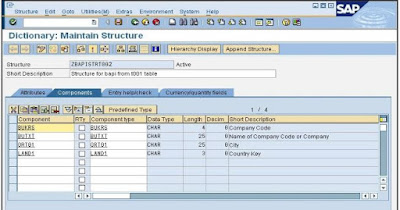
How to Create BAPI in SAP ABAP What is a BAPI Business Application Programming Interface(BAPI) is a interface providing us access to SAP and Non-SAP systems to process data from the remote systems. BAPI's are API methods which are stored in the Business Object Repository (BOR). BAPI is implemented as a function module which connects the New R/3 components, Information Warehouse (BW),Non-SAP software,Legacy systems,Isolating components within the R/3 System in the context of Business Framework,Distributed R/3 scenarios with asynchronous connections using Application Link Enabling (ALE) and Connecting R/3 Systems to the Internet using Internet Application Components (IACs). Business Application Programming Interface's(BAPI's) are standardized programming interfaces which enable external applications to access business processes and data in the R/3 System. BAPI provides us  seamless integration between the R/3 System and external applications and BAPI's defined a...